On this page
Last Updated on September 22, 2026 by Muhammad Toqeer
The joint you are looking at almost certainly has two different sealing systems in it. A utility pump’s discharge is typically a 1-1/4 inch NPT port, and the adapter in the box converts it to 3/4 inch garden hose thread — and those two standards seal in completely different ways.
Tape on the pipe end. A washer on the hose end. Get them the wrong way round, or treat both the same, and it drips no matter how hard you tighten it.
First: can you actually see the leak?
Worth thirty seconds, because the answer sends you to two different places.
Water on the floor, a drip at the fitting, a spray while it runs. That is the discharge side, and it is what this article is about.
Nothing visible anywhere, but the pump will not prime or keeps losing it. That is a suction-side leak, and it does not drip — the suction line runs below atmospheric pressure, so it draws air in rather than letting water out. A joint can be wide open and show you nothing. That is a genuinely different fault with a different test, covered in why a pump that will not prime often has no visible leak at all.
Everything below assumes you can see water.
The joint is two standards bolted together
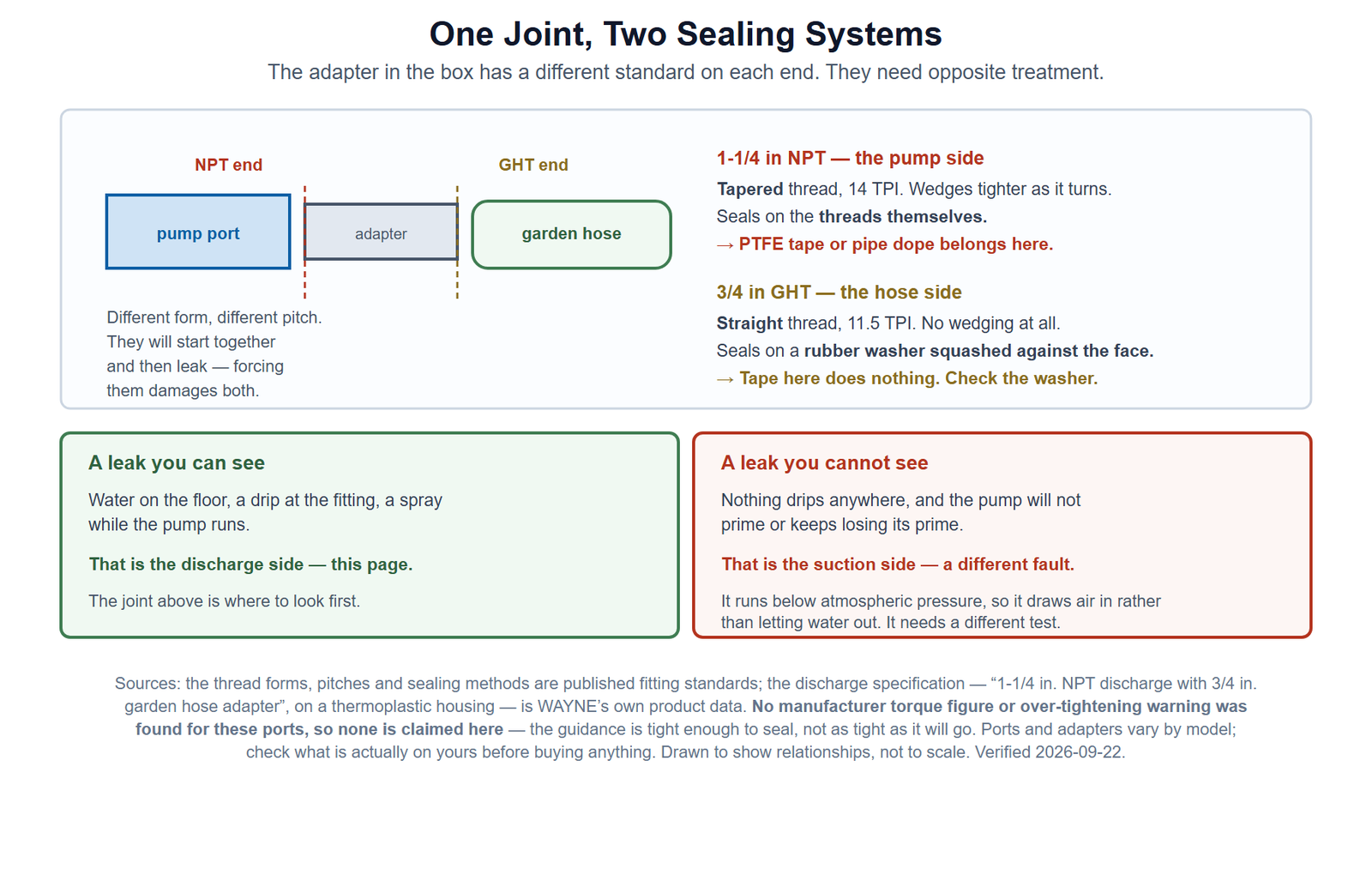
The pump end is NPT. Tapered threads, 14 per inch, which wedge tighter the further they go. An NPT joint seals on the threads themselves — metal or plastic jamming against metal or plastic — and that is exactly what PTFE tape and pipe dope are for. They fill the spiral gap the taper leaves.
The hose end is GHT. Straight threads, 11.5 per inch, no taper and no wedging. A garden hose joint seals on a rubber washer inside the female coupling, squashed flat against the face of the male fitting. The threads are only there to pull the two faces together.
That difference is the whole article, and it produces the two most common mistakes.
Mistake one: tape on the hose end
This is the one almost everybody tries, because tape is what you reach for when something drips.
On a garden hose thread it cannot work. The seal is a washer being compressed at the face; wrapping tape around a straight thread does nothing to improve that. You can wrap it three times and tighten it with pliers and it will still weep, because the leak is not coming from the threads.
What to check instead: is the washer there at all? Is it flat, hardened, or split? A hose washer is a consumable — they go missing when an adapter is swapped, and they harden with age and stop compressing. Replacing one costs almost nothing.
One-minute test: unscrew the hose and look into the female coupling. If you cannot see a rubber ring seated in the bottom, that is your leak and no amount of tape will fix it.
Mistake two: forcing the wrong thread
GHT and NPT differ in both form and pitch — straight against tapered, 11.5 threads per inch against 14. They are close enough to start together and completely unable to seal.
So a 3/4 inch garden hose will thread a turn or two onto a 3/4 inch NPT fitting and feel like it is working. It is not. As the fitting guidance puts it plainly, forcing a GHT fitting onto an NPT one “will damage both threads and cause leaks” — and once a plastic thread has been chewed, the part is finished.
If the two ends are not both the same standard, you need an adapter rather than more force.
One-minute test: count threads against a ruler on the male fitting. Garden hose thread gives you roughly 11 or 12 in an inch and the thread walls look parallel; pipe thread gives you 14 and visibly narrows toward the end. If the two parts you are joining do not match, no amount of tightening will seal them.
How tight is tight
Here the honest answer is that nobody publishes a number.
No manufacturer torque figure or over-tightening warning was found for these thermoplastic ports while researching this. What is verifiable is that NPT is tapered and wedges as it turns, and that these pump housings and impellers are thermoplastic. Those two facts together are a reason for restraint rather than enthusiasm.
So: tight enough to seal, not as tight as it will go. On the hose end in particular, a garden hose washer is designed to seal hand-tight. If you need a wrench on a hose fitting, the washer is the problem, not the torque.
While you are there
Check what the adapter is costing you in flow. It is not only a sealing question — a 3/4 inch adapter on a 1-1/4 inch port throttles the pump badly, and the bore of the hose matters more than almost anything else you can change.
And if the fitting has been leaking a while, look at what the water has been running onto. A pump sitting in its own leak in a place that was supposed to stay dry is a different problem from the one you started with — where the pump stands matters.
When this needs a pro
Not much here is dangerous, but two things are worth naming.
If the leak is at the pump body rather than the fitting — weeping from a seam, or from around the shaft — that is not a connection problem. That is the pump, and the fix is replacement rather than a washer. The buying guide covers what to look for.
If the thread on the pump’s own port is damaged, stop. A chewed port on a thermoplastic housing is not something to force an adapter into and hope, because the next failure is the port breaking off under pressure with the pump running.
And if there is water near anything electrical, deal with that first. For how the whole arrangement is meant to work, start with the utility and transfer pumps guide.
One caveat: ports and adapters vary by model. The 1-1/4 inch NPT discharge with a 3/4 inch garden hose adapter is a common arrangement and is what the figures above describe, but check what is actually on yours before buying anything.
FAQ
Why is my utility pump leaking where the hose screws on?
Usually because the wrong sealing method is being used for that end. A pump’s NPT port seals on tapered threads and needs PTFE tape or pipe dope. A garden hose connection seals on a rubber washer compressed against the face and needs the washer, not tape. The adapter between them has one of each.
Will Teflon tape stop a garden hose connection leaking?
No. Garden hose thread is straight, not tapered, and the seal comes from a rubber washer squashed against the face of the male fitting. Tape on a straight thread does not improve that. Check whether the washer is present, flat and soft.
Can I screw a garden hose straight onto a 3/4 inch NPT fitting?
It will start, and then leak. The two are different forms at different pitches — straight at 11.5 threads per inch against tapered at 14 — and forcing them damages both. Use an adapter.
How tight should the hose connection be?
Hand-tight on the hose end, because the washer is designed to seal that way. No manufacturer torque figure was found for these thermoplastic ports, so the sensible rule is tight enough to seal rather than as tight as it will go.
There is no drip anywhere but the pump keeps losing prime. Is that a leak?
Almost certainly, and on the suction side. That line runs below atmospheric pressure, so a leaking joint draws air in instead of letting water out — nothing drips and nothing looks wrong. It needs a different test from the ones here.


