On this page
Last Updated on September 20, 2026 by Muhammad Toqeer
Smell it properly before you clean anything. Musty or sour is biofilm in standing water, and cleaning fixes it. Rotten eggs or sulfur is hydrogen sulfide — sewer gas reaching your equipment — and no amount of scrubbing will touch it.
They are two different faults with two different repairs, and almost every guide treats them as one.
Musty, mildewy, sour
This is the common one and the benign one.
Condensate is not clean water. It arrives carrying dust, coil residue and whatever the air was holding, and then it sits — in the drain pan, in the line, and in a tank that is wet all season. That is a functioning incubator. The slimy layer that forms inside a wet drain line even has a name: zooglea, a bacterial film that builds on any surface kept permanently damp.
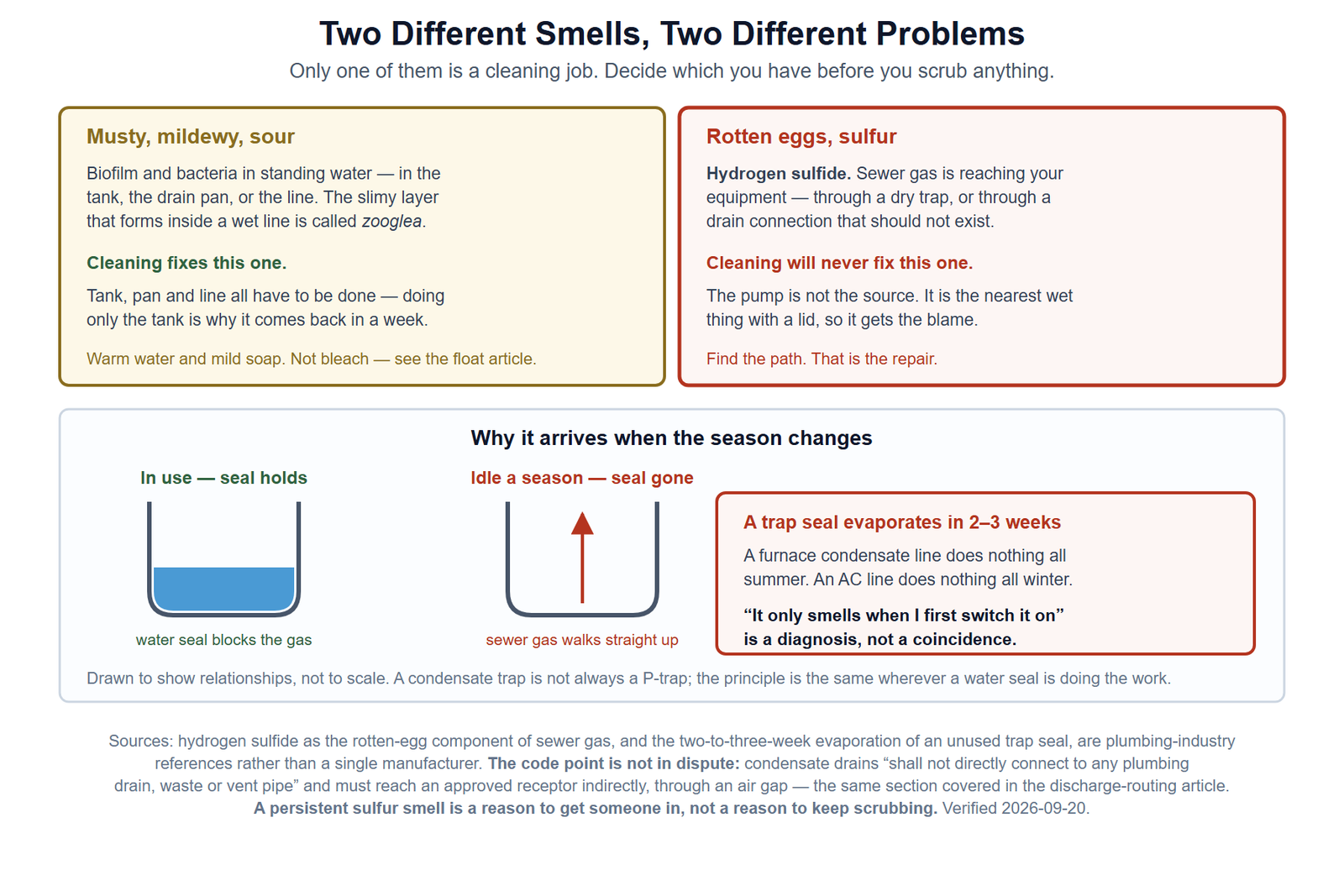
The mistake is cleaning only the tank. The tank is the part with a lid, so it is the part people do. But the pan above it and the line below it are wet for exactly as long, and if either is left the smell is back within a week or two and you conclude the cleaning did not work. It did — on a third of the problem.
So do all three, in order: the pan, the tank, then the line.
On the tank itself, there is a right method and it is not the one most articles give you. Neither Little Giant nor Sauermann calls for bleach, and there is a good reason not to reach for it — the detail is in how to free a stuck float without wrecking it, which covers the same tank and the same film. For the line, a vinegar flush is the usual answer and it is covered where a blocked line stops the pump moving water.
One-minute test: wipe a finger round the inside wall of the tank, above the water line. If it comes away slimy rather than gritty, you have biofilm and you are in this half of the article.
Rotten eggs or sulfur — a different problem entirely
If the smell is sulfurous, stop cleaning and start looking for a path.
That smell is hydrogen sulfide, the component of sewer gas responsible for its rotten-egg character, and it is detectable at very low concentrations. It does not come from condensate. Condensate has nothing in it to produce it. If you are smelling it at the pump, gas from the drainage system is getting to where the pump is.
There are two ways that happens.
A trap has dried out. Somewhere between your equipment and the sewer there is a water seal doing the work of keeping the two apart. When the water goes, so does the seal.
Or the condensate is hard-piped into a drain. It should not be. The code is explicit that condensate drains “shall not directly connect to any plumbing drain, waste or vent pipe” — they have to reach an approved receptor indirectly, across an air gap. That gap is not fussiness; it is the thing that stops exactly this. Where a condensate discharge is allowed to terminate covers the rule and the named list of receptors in full.
And the reason it matters more here than it would in a basement corner: the pump sits at the air handler. Whatever arrives there is next to the blower, and the blower distributes it.
One-minute test: does the smell get stronger when the system runs, or when it sits? Stronger while running points at something being drawn in and circulated. Stronger after a long idle spell points at a dried seal.
Why it shows up when the season changes
Here is the number that explains the most common version of this complaint.
A trap’s water seal evaporates in about two to three weeks of disuse. That figure is for an ordinary unused drain — and a condensate line is not merely unused, it is idle by design for months at a time. A high-efficiency furnace makes no condensate all summer. An AC coil makes none all winter. Either way, a line sits dry for a season, and two or three weeks is nothing against that.
Which is why “it only smells when I first switch the system on” is not a coincidence. It is the single most diagnostic sentence in this whole subject, and it points almost exactly at a seal that emptied while nothing was running.
If that is your case, the immediate step is simply to put water back: pour enough down the drain the line discharges into to refill the trap, and see whether the smell goes. That is a diagnosis as much as a fix — if it comes back next season, the line needs a proper answer rather than an annual top-up.
What to do, in order
- Identify the smell. Musty or sulfurous. Everything follows from that.
- If musty: clean the pan, the tank and the line — all three, not just the tank.
- If sulfurous: refill the trap of whatever the line drains into, and check how the discharge terminates.
- Look at the termination properly. If the condensate tube disappears into a pipe rather than ending in open air above a receptor, you have found the path, and that is the repair.
- If the tank is cracked, stained through, or the smell survives a genuine clean, the pump itself may be finished. The buying guide covers what to look for in a replacement, including the tank and check valve access that make the next clean easier.
When this needs a pro
A persistent sulfur smell is a reason to get someone in. Hydrogen sulfide is reported as toxic above 10 ppm and dangerous well above that; the concentrations from a dry trap in a house are far below those figures, but the symptoms attributed to low-level exposure — headaches, nausea, eye irritation — are the kind of thing people live with for months while blaming something else. More to the point, the smell is evidence of a path that should not exist, and the path is the problem whether or not the concentration is.
If the discharge is hard-piped into a drain, correcting that is plumbing work. It means adding a proper receptor and an air gap, and it is inspected.
If the smell is in the ductwork rather than the room, the pump is a bystander and you need someone looking at the coil and the pan.
And if you cannot find a source at all, do not keep cleaning the pump because it is the accessible part. For how the whole arrangement is meant to work, the condensate pumps guide is the place to start.
FAQ
Why does my condensate pump smell musty?
Standing water plus the dust and coil residue the condensate carries. A film of bacteria builds on every permanently wet surface — the pan, the tank and the inside of the drain line. Cleaning genuinely fixes it, but only if you do all three; cleaning the tank alone is why the smell so often returns within a week.
Why does my condensate pump smell like rotten eggs or sewage?
That is hydrogen sulfide from sewer gas, and condensate cannot produce it. Something is giving gas from the drainage system a path to your equipment — usually a trap that has dried out, or a condensate line hard-piped into a drain when it should discharge indirectly across an air gap. Cleaning the pump will not change it.
Why does the smell only appear when I turn the system on for the season?
Because a trap’s water seal evaporates in roughly two to three weeks of disuse, and a condensate line sits idle for a whole season by design — a furnace line all summer, an AC line all winter. The seal is long gone by the time you switch on.
Can I pour bleach into the condensate pump to kill the smell?
Neither Little Giant nor Sauermann calls for bleach, and Sauermann warns against solvents on parts you are trying to keep flexible. Warm water and mild soap is the published method for the tank.
Is the smell from the pump dangerous?
A musty smell is unpleasant rather than hazardous. A sulfur smell is different — not usually dangerous at household concentrations, but it means sewer gas has a route into the space next to your blower, and that route is worth closing regardless of how strong the smell is.


