On this page
Last Updated on September 16, 2026 by Muhammad Toqeer
Before you choose: a standard condensate tube is 3/8 inch inside and 1/2 inch outside. Same tube. So a good share of every “3/8 or 1/2?” argument is two people quoting different sides of one piece of vinyl, and the answer to the question as asked is usually “those are the same thing.”
Once that is out of the way there is a real rule underneath — and the reasons you will be given for it are wrong.
One tube, three numbers
Clear condensate tubing comes with a 1/16 inch wall. Add that wall to each side of a 3/8 inch bore and you get exactly 1/2 inch across the outside:
3/8 + 1/16 + 1/16 = 1/2
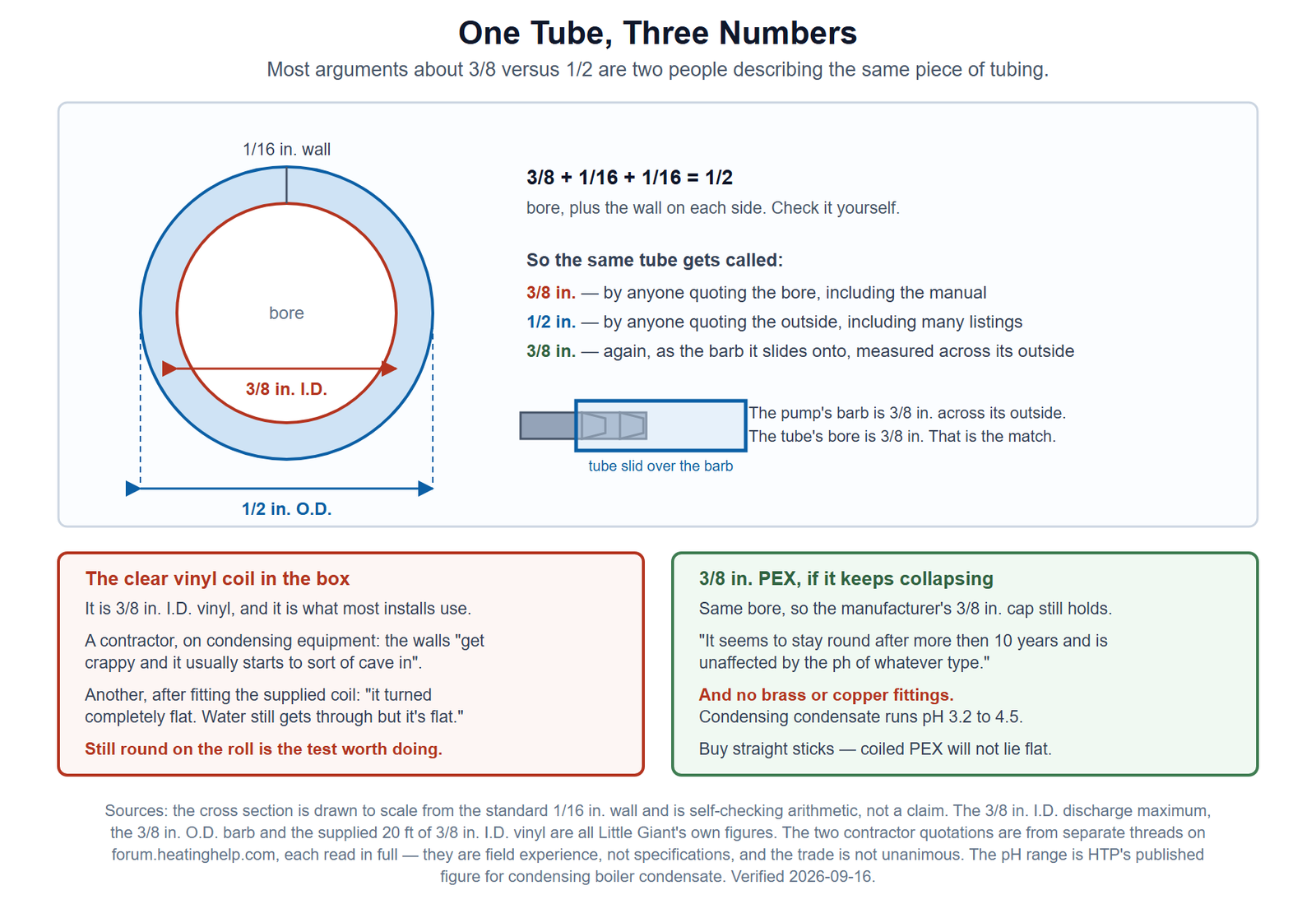
So one piece of tubing is called:
- 3/8 inch by anyone quoting the bore, which includes the pump manufacturer
- 1/2 inch by anyone quoting the outside, which includes a lot of retail listings
- 3/8 inch again by the fitting it slides onto — the pump’s discharge barb is 3/8 inch measured across its outside
Three numbers, two of them the same number meaning different things. That is the whole confusion.
One-minute test: measure the hole, not the tube. A ruler across the open end tells you the bore, and the bore is what every specification means.
The cap is real. The reasons you will be given are not.
Little Giant’s installation sheet does set a limit, and it is a maximum rather than a target:
“The outlet piping should be flexible tubing… (3/8 inch I.D. maximum to prevent excessive flow back to unit).”
Bigger bore, more water sitting in the line, more of it running back into the tank when the motor stops. That is the manufacturer’s reason and it is the correct one. What that costs you in practice — short cycling, a pump that never seems to finish — is covered in why a pump runs but moves no water, which is where this rule lives as a fault.
Now the two explanations you will find instead, both of which circulate widely:
“A wider tube holds a heavier column of water, so the pump has to work harder.” This is wrong. The pressure a column of water puts on a pump depends on its height, not its width — a 1/2 inch column and a 3/8 inch column ten feet tall push back with exactly the same pressure. The wider one holds more volume, which is a different problem with a different consequence, and the consequence is the backflow the manufacturer names. If you have been told the pump “can’t lift” the fatter column, you have been given a true conclusion with a false reason, which is worse than useless when you try to reason from it.
“For runs over 50 feet, go up to 1/2 inch to reduce friction loss.” Friction loss in a long narrow bore is real physics and the advice is not stupid. But it collides head-on with a published manufacturer maximum, and on this equipment the manufacturer wins — a condensate pump is a 1/30 horsepower motor moving on the order of a gallon an hour. The backflow that a wider bore causes shows up on every single cycle. The friction penalty shows up only at flow rates this pump never reaches.
If your run genuinely is that long, the answer is not a fatter tube. It is a pump chosen for the head, which which condensate pump you need works through. And if that points at a different pump, the buying guide covers which current models still deliver a real figure at fifteen feet.
The tubing in the box is the part that fails
This is what the sizing question is usually standing in front of, and it is a material question rather than a dimensional one.
The pump ships with vinyl — Little Giant’s catalog lists “20′ x 3/8″ I.D. vinyl discharge tubing” on the models that include it. It is the right size. Whether it is the right material depends on what is making the condensate.
A contractor on a heating forum, describing what he has seen specifically on condensing equipment:
“I’ve found that especially when used w condensing equipment that the tubings wall get crappy and it usually starts to sort of cave in.”
And a second thread opens with the failure itself:
“So I ran some clear vinyl tubing like what came with the pump and it turned completely flat. Water still gets through but it’s flat.”
The reply is the useful part: “Usually that vinyl collapses if there is a negative pressure, or excessive temperature. If it came off the roll round, generally it stays that way.”
The trade is not unanimous about this, and it would be dishonest to pretend otherwise — another contractor in the same discussion says the cheap clear vinyl from a box store “works fine for this application.” On an air conditioner, where the condensate is cool and near-neutral, that is probably true. On a condensing furnace or boiler it is the case where people report trouble.
One-minute test: look at the coil before you fit it. If it came off the roll oval, it will not become round on the wall.
Why no brass and no copper
The reason is chemistry the site has already established: condensate from condensing equipment runs at a pH of 3.2 to 4.5. That is mildly acidic water, continuously, for years.
So when a contractor says of PEX “and no brass or copper fittings of course”, that is not fussiness. Brass and copper in a permanently acidic drip are consumable.
Which makes the exception worth knowing, because it looks like a contradiction and isn’t. From the same discussion, a deliberate use of copper:
“In any case where the vinyl terminates….sink…stand pipe or floor drain….I put a short piece of 3/8″ OD copper in the end. This is the acid indicator for me…if the copper is getting thin then there is potential for damage to the cast iron/copper DWV system…..poor man’s acid test.”
Copper is wrong as a structural fitting for exactly the reason it is useful as a sacrificial one. A short stub at the open end costs nothing, is not holding anything together, and tells you what the condensate is doing to the drain system it is being poured into. If that stub thins, the answer is a neutralizer, not a different tube.
If you swap to PEX, one practical note from the same thread: “buy straight sticks, the coiled PEX doesn’t like to stay straight.”
The inlet side, which nobody specifies
Worth saying plainly because people go looking for a number that does not exist.
The installation sheet says only: “Run flexible tubing or pipe from evaporator drain into one of the three pump inlets. Be sure inlet piping is sloped downward to allow gravity flow.” No size is given anywhere.
That is not an oversight. The inlet openings are 1-1/8 inch holes and the line is not pressurised — whatever comes off your equipment’s drain stub, sloping downhill, is what goes in. The constraints on the inlet are about depth and angle rather than diameter, and they are in where to install a condensate pump along with the rest of the placement rules.
When this needs a pro
A tube that keeps collapsing is telling you about temperature or suction, not about tubing. Vinyl going soft points at condensate hotter than the tube is rated for, and a tube pulling flat points at a restriction downstream of it. Changing material may fix the symptom while the cause is still there.
Do not reduce the bore to “help” it. Going below 3/8 inch is not the mirror image of going above it — the manufacturer set 3/8 as a maximum, not as a range, and a narrower line on a pump with a check valve is a blockage waiting to happen.
And if the copper test tells you the condensate is aggressive, the fix is a neutralizer upstream, which is plumbing work on the equipment rather than a tubing choice. The condensate pumps guide covers what these systems are doing and why the chemistry differs between a furnace and an air conditioner.
FAQ
Should condensate pump tubing be 3/8 or 1/2 inch?
Usually those are the same tube. Standard clear condensate tubing is 3/8 inch inside diameter with a 1/16 inch wall, which makes it 1/2 inch outside. The specification that matters is the bore, and Little Giant sets 3/8 inch inside diameter as a maximum for the discharge.
What happens if the discharge tubing is too big?
Water that the pump has just lifted runs back down into the tank when the motor stops — the manufacturer’s phrase is “excessive flow back to unit”. The float rises again, the pump runs again, and it short cycles. It is not a lifting problem, which is what most explanations get wrong.
Can I use 1/2 inch tubing for a long run to reduce friction?
That advice circulates and it contradicts the manufacturer’s published maximum. On a 1/30 horsepower pump moving about a gallon an hour, the backflow a wider bore causes happens on every cycle, while the friction penalty never really arrives. If the run is long, choose the pump for the head instead.
Is the tubing supplied with the pump any good?
It is the correct size. On an air conditioner it is usually fine. On condensing equipment contractors report the walls softening and the tube collapsing flat over time, and switch to 3/8 inch PEX, which holds its shape and is unaffected by the acidity.
What size tubing goes into the inlet of a condensate pump?
The manufacturer does not specify one. The inlet openings are 1-1/8 inches and the line is gravity-fed, so what matters is that it slopes downhill the whole way and is cut and inserted correctly — not its diameter.


