On this page
Last Updated on September 14, 2026 by Muhammad Toqeer
Ignore most of what you will read about this. The standard advice — check for an air leak, check the foot valve, check the strainer, fill the pump — is written for a pump that never worked. Yours worked. It primed, it moved water, and then it stopped, which rules out nearly all of that before you start.
What is left is short: four things change while a job runs, and the first one is the job itself.
The falling level is the fault, not the background
You are removing the water that the pump needs in order to keep working. That sounds obvious said out loud, and almost nobody accounts for it.
As the surface drops toward the intake, a rotating depression forms above it. Past a certain depth that whirlpool reaches down far enough to start feeding air into the suction line, and the pump begins passing a mixture instead of water. That is why the failure has a distinctive shape: the flow does not stop cleanly, it surges and fades first, often with a change in the sound.
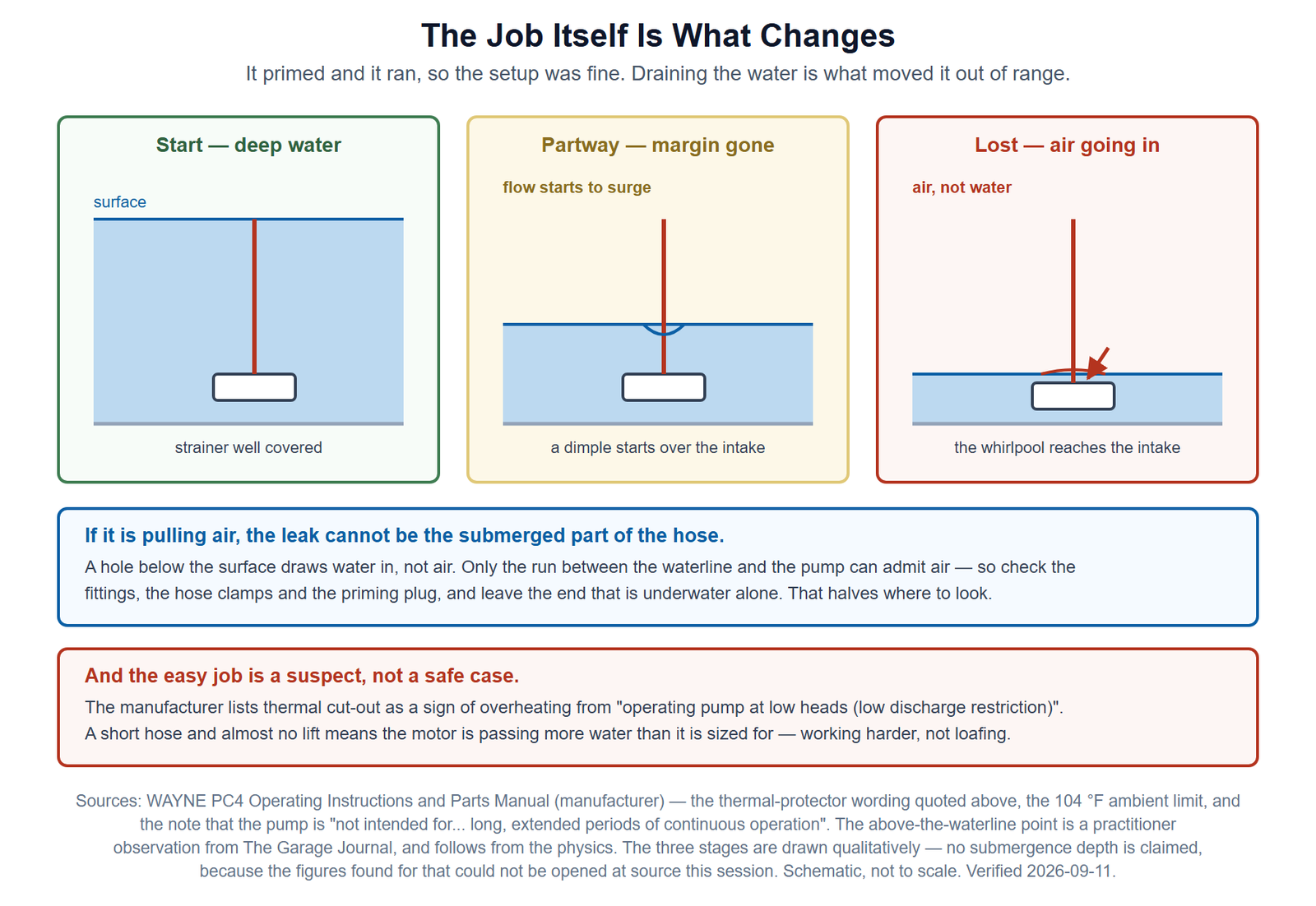
One-minute test: look at the surface directly over the intake while it runs. A dimple or a spinning dent means you are at the edge; a visible funnel means you are past it.
The fixes are all about putting more water over the intake, not about the pump. Move the strainer to the deepest part of whatever you are draining. Lay the suction hose so the end sits in a low spot rather than on a shelf. If you are draining a pool cover or a shallow pit, accept that the last inch is a different job — a wet vac or a smaller pump finishes it.
The leak is above the waterline
If the pump is pulling air rather than water, there is one place the air cannot be coming from: the submerged part of the hose.
A hole below the surface draws water in. It cannot admit air, because there is no air there to admit. So the only stretch that can be the culprit is the run between the waterline and the pump — fittings, clamps, the hose body above the water, and the priming plug.
A contractor on a pump forum put it in one line while diagnosing a lake-fed pump: “if your sucking air the leak is not under the water.”
That halves the search, and it contradicts every checklist that tells you to inspect the whole suction line. Wayne’s manual is blunt about how small a leak needs to be: “Small leaks in suction line greatly reduce efficiency of pump and may prevent priming.”
The priming plug deserves its own mention, because the manufacturer explicitly asks for sealant tape on it “to prevent air leaks” — and a plug that was tight when cold is a common thing to find finger-loose after an hour of vibration. If you want the full treatment of the suction side, that is why a utility pump won’t prime.
The intake settled into what you stirred up
The third thing that changes is what the strainer is sitting in.
Debris concentrates as the water goes. What was a strainer in reasonably clear water at the start is, an hour later, a strainer in the silt that all that water was carrying — and if the intake is resting on the bottom, it is also being pulled into whatever it is sitting on.
A forum account of exactly this, on a pump drawing from a lake: “Mine sucked up sand from the lake bottom and would lose prime immediately upon shutdown. Cleaned the sand out and it’s been fine for six weeks now.”
One-minute test: pull the strainer out and look at it. If the fix is obvious, it is also temporary — get the intake off the bottom before you restart, on a brick, a board, or hung a few inches up.
The motor got hot — and the easy job is the suspect
This one is genuinely backwards from what people assume, and it is in the manufacturer’s own words.
Wayne’s PC4 manual: “Pump motor is equipped with an automatic resetting thermal protector and MAY restart unexpectedly. Protector tripping is an indication of motor overheating because of operating pump at low heads (low discharge restriction), excessively high or low voltage, inadequate wiring…”
Low heads. Low discharge restriction. A pump with a short hose and almost no lift is not taking it easy — it is passing far more water than the motor is sized for, and working harder than the same pump pushing up a wall. So the quick, simple, nothing-to-it job is a legitimate cause of a mid-job thermal cut-out, and the awkward high-lift job is not.
Two more lines from the same manual make the picture complete:
- “This pump is not intended for permanent installation or long, extended periods of continuous operation.” These are not continuous-duty machines.
- “Ambient temperatures around the motor should not exceed 104F (40C).” An air-cooled motor sitting in direct sun on a summer afternoon is already close to that before it does any work.
If yours stopped after a long run on a hot day with a short hose, you have probably found it. Let it cool, and give it a break in the cycle rather than running it flat out. A pump that keeps cutting out on heat is heading toward the broader running-but-not-moving-water picture.
What has almost certainly not happened
Worth saying, because the instinct is to assume wear.
The impeller has not worn out in the middle of one afternoon. The seal has not chosen this hour to fail. A pump that ran and then stopped, on a job it had been managing, is far more likely to be reporting a change in its conditions than a change in itself. The parts that genuinely do fail — the seal after a long dry run, the impeller when something hard goes through it — announce themselves differently, and they do not usually wait until twenty minutes in.
Start with the four things above. The background on what these pumps can and cannot do is in the utility and transfer pumps guide.
When this needs a pro
One specific safety point, and it is not boilerplate — it comes from the same manual sentence quoted above.
The thermal protector is automatic resetting, and Wayne warns in capitals that the pump “MAY restart unexpectedly.” So a pump that has stopped is not a pump that is off. It can come back to life on its own, without anybody touching it, while your hand is in the strainer. Unplug it at the outlet before you touch the intake — not the switch, the plug.
Beyond that: a pump tripping the GFCI rather than stopping quietly is an electrical fault and not something to solve by finding an unprotected outlet. And a pump that has been run dry for a long stretch chasing the prime may already have a damaged shaft seal, which shows as a leak between the motor and the pump body. That is a replacement decision, not a mid-job fix — and if it comes to that, the buying guide sets out the trade-off between how much water a pump moves and how close to dry it gets.
FAQ
Why does my transfer pump lose prime after working fine for a while?
Usually because the water level dropped far enough for a vortex to form over the intake and start pulling air in. The other three candidates are an air leak in the section of hose above the waterline, a strainer that has settled into silt, and a thermal cut-out from the motor overheating.
How do I know if it is an air leak or the water level?
Look at the surface over the intake while it runs. A spinning dimple or a funnel means the level is the problem. If the surface is flat and it is still pulling air, the leak is in the hose run above the waterline — a submerged hole would draw water, not air.
Can a pump overheat on an easy job?
Yes, and it is more likely there than on a hard one. The manufacturer lists overheating from “operating pump at low heads (low discharge restriction)” — a short hose with no lift means the motor is moving more water than it was sized for.
My pump stopped. Is it safe to clear the strainer?
Not until it is unplugged. The thermal protector resets itself automatically and the manual warns the pump may restart unexpectedly, so a pump that has gone quiet can start again on its own. Pull the plug, not the switch.
Does losing suction damage the pump?
It can, if it keeps running dry. The shaft seal is what suffers, and the damage comes from the running rather than the losing. If the flow surges and fails, stop it rather than letting it chase air for another ten minutes.


