On this page
Last Updated on September 16, 2026 by Muhammad Toqeer
Almost never on top of it, but the furnace is not what you should be measuring against. The pump’s inlet has to sit below the condensate trap’s outlet, and the trap is not where people assume — on an upflow it stands at least six inches tall beside the cabinet, and on a horizontal unit it hangs as much as five inches below the cabinet’s underside.
So “above the furnace” is the wrong question. There are three heights that decide this, and the furnace’s own height is not one of them.
Height one: the trap outlet, which moves with the orientation
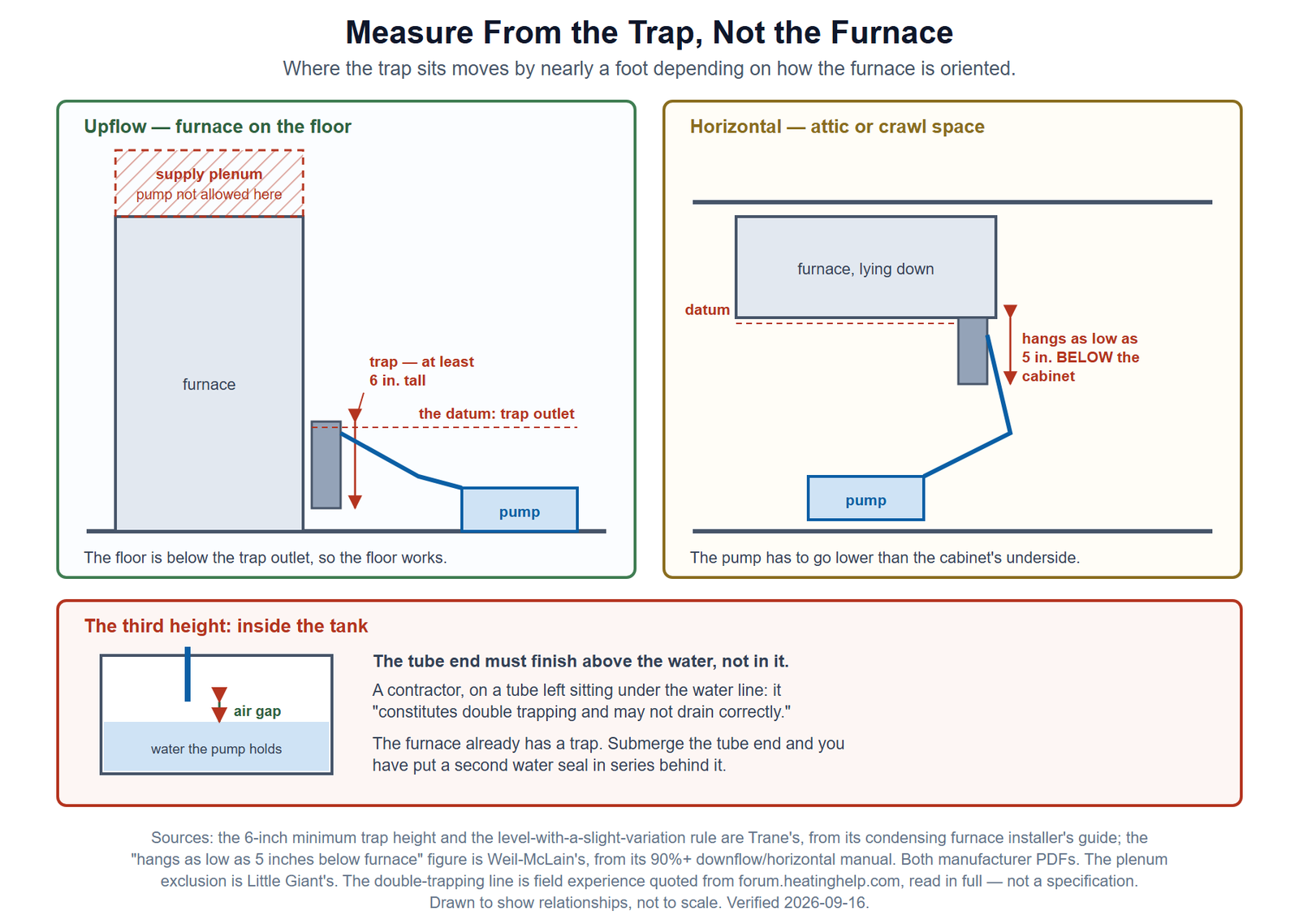
Trane’s installer guide for its condensing furnaces sets a floor on the trap itself: “Condensate trap for vent pipe must be a minimum of 6 inches in height.” On an upflow furnace standing on a basement slab, that puts the outlet a hand’s width up the side of the cabinet — comfortably above anything sitting on the floor beside it. The floor works.
Now turn the same furnace on its side, which is what happens in an attic or a crawl space. Weil-McLain’s manual for its 90%-plus downflow and horizontal furnaces:
“In horizontal position, condensate trap hangs as low as 5 inches below furnace. Provisions must be made for condensate trap and drain lines.”
The datum has moved below the bottom of the cabinet. A pump tucked up against the underside of a horizontal air handler is above the trap outlet even though it is below the furnace — and it will not fill.
That is the whole reason attic and crawl installs are the awkward ones, and no page framing this as “above or below the furnace” can explain it.
One-minute test: find the trap, not the furnace. Put a finger on the point where the drain line leaves it. Everything after that has to run downhill.
Height two: the water already inside the pump
This one is not in any manual and it catches good installers.
The pump holds water between cycles — a VCMA switches on at roughly 2-1/4 inches and off at roughly 1-1/4, so there is always an inch or so standing in the tank. The drain tube coming from the furnace has to finish above that line.
A contractor on a heating forum, on a tube left sitting under it:
“Just do not let the furnace drain hose be under water in the pump or this constitutes double trapping and may not drain correctly.”
And earlier in the same thread, as an instruction: “Check the end of the drain where it enters the pump. Make sure it does not go to the bottom of the pump. Give it a air gap.”
The furnace already has a trap — a deliberate water seal. Push the tube end under the water in the pump and you have put a second water seal in series behind the first. Two traps in a row on a line with no pressure behind it is a line that drains when it feels like it.
This sits alongside the manufacturer’s own instruction about how far in the tube goes — one to three inches into the tank, cut at an angle — which is in where to install a condensate pump with the rest of the placement rules. Far enough in to clear the float, high enough up to clear the water.
Height three: the plenum boundary
If “above the furnace” means literally on top of an upflow cabinet, there is a second and independent reason not to, and it has nothing to do with gravity.
The top of an upflow furnace is where the supply plenum starts. Little Giant’s installation sheet is one line: “This pump is not intended for use inside air plenums.” A standard pump in an air-handling space is the wrong product regardless of how the tubing runs — that needs plastics tested to UL Standard 2043, and the buying guide covers which models carry that listing.
Setting a plastic tank of acidic water on top of a running furnace is not a great idea for the other obvious reasons either, but the listing is the one that settles it.
The furnace is tilted on purpose. The pump is not.
Worth knowing because it looks like an inconsistency when you see both installed.
Trane: “The furnace must be installed level. The only allowable variation would be slightly to the left and/or forward in upflow installations or slightly toward the front in horizontal installations. This is necessary for proper condensate drainage.”
So the furnace is permitted a deliberate lean, toward its own drain. Meanwhile the pump beside it has to be dead level, because its float switching points are referenced to the tank.
Two machines a foot apart, opposite requirements, and the same reason behind both: getting water to go where it is supposed to.
Yes, a pump is an approved termination
Worth stating plainly, because people ask whether the furnace manufacturer permits one at all.
Trane’s guide lists the options for what the trap connects to: “a condensate drain pump; an open or vented drain; or it can be connected to the outlet hose of the furnace’s condensate trap.” A pump is first on the list.
Two details from the furnace side that go with it. Weil-McLain: “Field installed drain line from furnace must flow downhill from furnace trap” — the same rule from the other direction. And “The furnace’s drain trap must be primed. This is easily done by pouring a few cups of water into furnace vent pipe after drain installation is complete.” A dry trap on a condensing furnace is its own fault and it is not the pump’s doing.
One more thing the furnace makers say that the pump makers also say, from Weil-McLain: “This furnace produces a slightly acidic condensate as a by-product of combustion.” That is why the material of everything downstream matters, which is covered in the tubing size guide.
What to do when there genuinely is no room below
Because that is usually why the question gets asked.
Lower the pump, do not raise the reference. A pump does not have to sit on the floor — it can go on a wall bracket, in a pan, or on a low platform, as long as its inlet is still under the trap outlet. On an upflow with a six-inch trap you have more vertical room to play with than it looks.
On a horizontal unit, plan for the trap before the pump. The trap hanging below the cabinet is the constraint, and it is the thing that has to be accessible as well — the model code requires drains to be configured so blockages can be cleared without cutting the line.
If there is truly nothing below the trap, the answer is not a pump mounted high. It is either relocating the equipment’s drain connection, which is the installer’s call, or a different class of product designed to be fed under pressure — not a tank-and-float pump, which only ever fills by gravity.
When this needs a pro
An attic or over finished space brings code into it. Where an overflow would damage the building, the model code wants secondary protection — an auxiliary pan, a secondary drain, or a UL 508 water-detection switch wired to shut the equipment down. That is a jurisdiction question, not a preference.
Anything that means moving the furnace’s own drain connection or re-orienting its trap is furnace work, not pump work. The trap’s port arrangement changes between upflow, downflow and horizontal, and getting it wrong shows up as a pressure-switch fault rather than a water problem.
And if the pump is already fitted high and the line is not draining, resist the urge to add a second pump or a bigger one. Check the two heights first. For the background on what these systems are doing, the condensate pumps guide has it.
FAQ
Can a condensate pump be installed above the furnace?
Not on top of it, and the furnace is the wrong reference anyway. The pump’s inlet must sit below the condensate trap’s outlet. On an upflow furnace the trap is at least six inches tall beside the cabinet, so the floor works. On a horizontal unit the trap hangs below the cabinet, so the pump has to go lower still.
Why won’t my condensate pump fill if it’s below the furnace?
Probably because it is not below the trap. In a horizontal or attic installation the trap can hang as much as five inches under the cabinet, so a pump tucked beneath the furnace can still be above the point the water actually leaves from.
How far should the drain tube go into the pump?
One to three inches into the tank per the manufacturer, and — the part nobody prints — the end must stay above the water the pump holds between cycles. A submerged tube end puts a second water seal in series with the furnace’s own trap, which contractors call double trapping.
Does the furnace have to be level if the pump does?
Not in the same way. The furnace is allowed a slight deliberate lean toward its drain — Trane permits “slightly to the left and/or forward” on an upflow. The pump must be dead level, because its float switching points are referenced to the tank rather than to the room.
Is a condensate pump an approved way to drain a high-efficiency furnace?
Yes. Trane’s installer guide lists a condensate drain pump as the first option for what the trap connects to, alongside an open or vented drain. The requirement is on how it is connected, not on whether a pump is allowed.


