On this page
Last Updated on September 3, 2026 by Muhammad Toqeer
Get this one wrong in either of two ways and it costs you. Most of these pumps have two floats, not one, and freeing the wrong one leaves you certain the pump is dead when it isn’t. Then there’s the cleaning: the bleach solution every guide recommends is not what either manufacturer’s own documentation asks for, and the wrong chemical damages the float you’re trying to rescue.
So: find out which float, test it the way the manual does, and clean it with the right thing.
There are two floats, and they do different jobs
Open a Little Giant VCMA-series pump — the shape most US basements have — and the cover assembly carries a motor switch float and a safety switch float.
The motor switch float is the one that starts the pump when water reaches about 2-1/4 inches and stops it at about 1-1/4. The safety switch float sits higher, and it doesn’t drive the pump at all: it’s wired into the low-voltage circuit that shuts your heating or cooling down when the tank keeps filling.
That difference decides what you’re looking at:
- Pump won’t run, tank full, furnace still working. The motor switch float is the suspect.
- Pump won’t run and the furnace or AC is dead too. The tank filled far enough for the safety float to do its job. That’s one fault, not two, and the pump is still the thing to fix — there’s more on why the system goes down with it.
- Pump runs, but stops before the tank is empty and restarts later. That isn’t a float at all — it’s the motor’s thermal protector.
Every guide on this saying “check the float” is describing one of two parts and not telling you which.
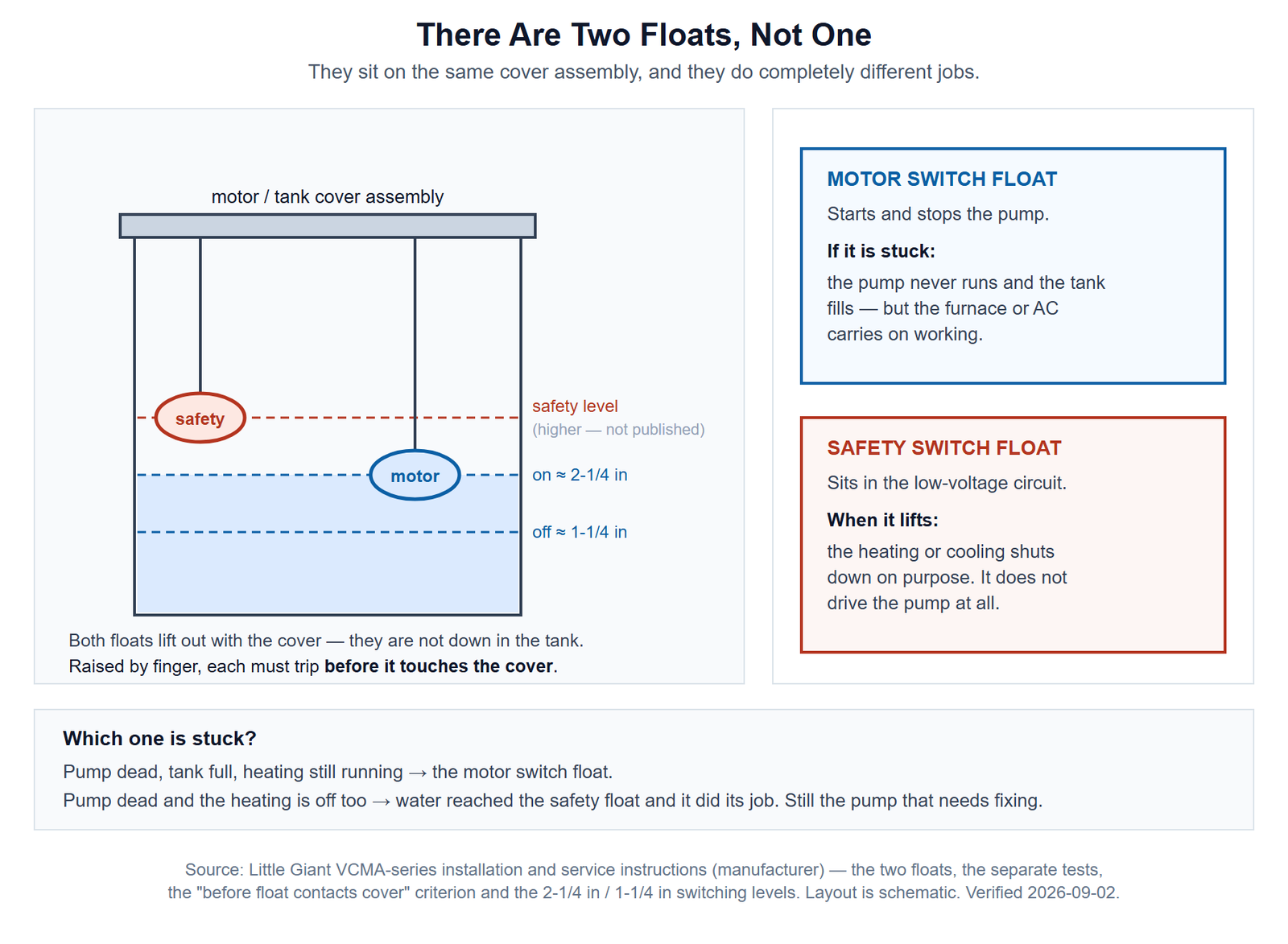
Because they sit at different heights, the water reaches them in order — the motor float first, and the safety float only if the tank keeps filling past it.
Getting to them
The manual’s first line is the one to take seriously: “Make certain that the unit is disconnected from the power source before attempting to service or remove any component.” Unplug it. If it’s hardwired, kill the breaker.
Then, in Little Giant’s own words, “remove motor/tank cover assembly and hold level.” The floats come out with the cover — they’re not down in the tank. Holding it level matters, because tipping the assembly swings the float arms and you lose the chance to see how they were sitting.
Look at the arms before you touch anything. A float that’s fouled will usually show a tide line or a dull film on the underside where it has been sitting in the water.
The test the manual specifies — and the bit that makes it a test
Here’s what nobody quotes. Little Giant doesn’t say “lift it and see if the pump comes on.” It gives a threshold:
“Test motor switch by raising motor switch float with finger. Motor should turn on just before float contacts cover.”
And separately, for the other one:
“Test safety switch by raising safety switch float with finger. Safety switch should activate before float contacts cover.”
One-minute test: with power on and the cover assembly held level, raise each float with a finger in turn. Each should trip before it reaches the cover. If a float only trips when it’s jammed hard against the cover, or doesn’t trip at all, that one is your problem. If it trips early and cleanly, that float is fine and you can stop suspecting it.
The word doing the work is before. A float that’s partly gummed still moves, just not far enough or freely enough, and the only way to catch that is to know where it’s supposed to trip.
Freeing it, and what not to clean it with
A light tap frees a float that’s lightly stuck, and that’s genuinely where to start. Beyond that it’s a clean, not a fight — the float support is fragile enough that Sauermann’s own guidance warns it “is fragile and poses an injury risk”.
Now the part worth getting right. Little Giant’s service instructions say: “Clean the tank with warm water and mild soap.” Sauermann is more specific about what to keep away from it: “don’t use hydrocarbon-based products or solvents such as acetone, as these will damage the seal and the float itself.”
Neither manufacturer says bleach, which is what most articles on this recommend. A float and its seal are the parts you’re trying to save; a solvent that attacks them turns a cleaning job into a replacement.
So: warm water, mild soap, a soft brush on the float and its arm, and the same on the tank while it’s open. Rinse it properly and let it drain before it goes back together. Rinsing alone leaves biofilm behind, which is why a pump “cleaned” without scrubbing sticks again within weeks.
When it goes back, check the float’s orientation. On a Sauermann float the instruction is explicit — “the inner ring should be facing upwards” — and getting it inverted on any pump gives you a float that can’t do its job.
Why it stuck, which explains when it happens
Sauermann names the contaminants: “biofilm, lacquers, aerosols or even dust in the condensate, even in small amounts, can be problematic: as these pollutants dry out, they can cause the float … to become stuck.” Dust and spiders’ webs get a mention too, along with blockages that build up during winter inactivity.
The mechanism there is worth sitting with, because it isn’t what you’d assume. The float doesn’t seize because it’s drowning in slime. It seizes because a film dries onto it while the pump sits idle. That’s why these turn up stuck at the start of a season rather than in the middle of a hot, busy August — the pump stopped, the residue dried, and the float was glued in place by the time it was needed again.
Aerosols and lacquers on that list are a hint about where the fouling comes from. Anything sprayed into the air near an air handler ends up in the condensate.
One mechanical cause that isn’t fouling at all: the inlet tube. Little Giant asks for it to extend into the tank “from 1 to 3 inches to ensure that it will not interfere with proper float operation.” Pushed deeper, the tube leans on the float and holds it where it shouldn’t be. Nothing is stuck; something is in the way.
One-minute test: look at how far the inlet tube pokes into the tank. More than about three inches, shorten it.
When the float is past cleaning
Sauermann gives the cleanest criterion anywhere on this: replace it when “the float sinks but fails to rise with the water level.” A float that has cracked and taken on water no longer floats, and no amount of cleaning brings that back.
On a Little Giant VCMA the float arm is a stocked part — it appears in the manual’s own parts list as part 154452 — so a cracked float doesn’t automatically mean a new pump. Whether it’s worth doing depends on the age of the rest of it, and on a pump that’s already had a hard life you may be better replacing the unit. Check the lift your discharge line actually needs before you choose a replacement; the condensate pump guide has the GPH-versus-height figures.
When this needs a pro
The safety switch float is where to stop. Its switch sits in the low-voltage control wiring of your furnace or air handler, and if that float or its switch is the failed part, the repair puts you inside the equipment’s control circuit rather than inside the pump. Get a tech.
The same goes if you free the float, the pump runs, and the tank still overflows — that’s a discharge problem hiding behind a float problem, and it will flood the same spot again.
And never jumper the safety switch out to get the heat back on while you sort the pump. That switch is the only thing between a tank that won’t empty and water coming through a ceiling.
FAQ
How do I know which float is stuck?
Raise each one with a finger while the cover assembly is out and held level. The motor switch float should start the pump before it touches the cover; the safety switch float should trip before it touches the cover. Whichever one doesn’t is the one you’re cleaning.
Can I use bleach to clean a condensate pump float?
Little Giant’s service instructions call for warm water and mild soap, and Sauermann warns against solvents on the grounds that they damage the seal and the float. Neither manufacturer recommends bleach, which is worth weighing before using it on the part you are trying to save.
Why does my float keep sticking after I clean it?
Usually because it was rinsed rather than scrubbed. The film that sticks a float is biofilm and dried residue, and it survives rinsing. The other possibility is the inlet tube sitting too far into the tank and physically holding the float.
Should I just replace the float or the whole pump?
Replace the float if it’s cracked and the pump is otherwise sound — the float arm is a stocked part on a VCMA. Replace the pump if the motor has been struggling as well, or if the unit is old enough that you’d be back inside it next season.
Is a stuck float why my furnace stopped?
It can be, indirectly. If the pump can’t empty the tank, the water rises to the safety float, and that switch shuts the equipment down on purpose. Fix the pump and the heating comes back.


