On this page
- Two One-Minute Checks Before You Price a Generator for Your Well Pump and Sump Pump
- Why a 240V Circuit and a 120V Outlet Still Draw From One Pool
- The Combined Number: A 1 HP Well Motor's Locked-Rotor Surge Against a Sump Pump's Circuit
- A Float Switch Doesn't Wait for the "Start Your Biggest Motor First" Advice
- Sizing It Anyway: A Worked Example
- Where This Stops Being a Weekend Project
- A Battery Backup Covers the Gap a Generator Can't
- FAQ
- Size for the Collision, Not the Addition
Last Updated on October 17, 2026 by umar bwn
Size the generator for the moment the well pump’s starting surge and the sump pump’s own start happen together, not for the sum of what each one draws while running. A portable generator’s rated wattage is one shared pool across every outlet it has — the 240V circuit feeding your well pump and the 120V duplex outlet feeding your sump pump are pulling from the same total, not two separate budgets. And a sump pump’s float switch doesn’t ask permission before it starts, so you can’t count on starting one motor at a time the way the generator’s own manual assumes.
Two One-Minute Checks Before You Price a Generator for Your Well Pump and Sump Pump
Before any arithmetic, two things decide whether the rest of this even applies to you.
Check your sump pump’s manual or model tag for the word “generator.” Wayne’s current submersible sump pump manual (`600002W-001-J`, 06/25) states outright, across fourteen models spanning its SPF, CDT, WST, CDU and CDU-SS lines: “These pumps are not designed to be used with a portable generator.” It’s in the pump description section, not buried in a warranty exclusion. If your sump pump is one of those models, the sizing question below is academic — read your own manual before you shop, because this is one maker’s stated position and nothing here overrides it. Liberty’s sump and sewage manuals held for this site mention generators zero times, which isn’t permission, just silence.
Find your well pump’s nameplate data — horsepower, voltage, and whether it’s a 2-wire or 3-wire motor. You’ll need it for the next section, and it’s usually on a tag at the pressure switch, control box, or well cap, not on the motor itself thirty feet down the casing.
Why a 240V Circuit and a 120V Outlet Still Draw From One Pool
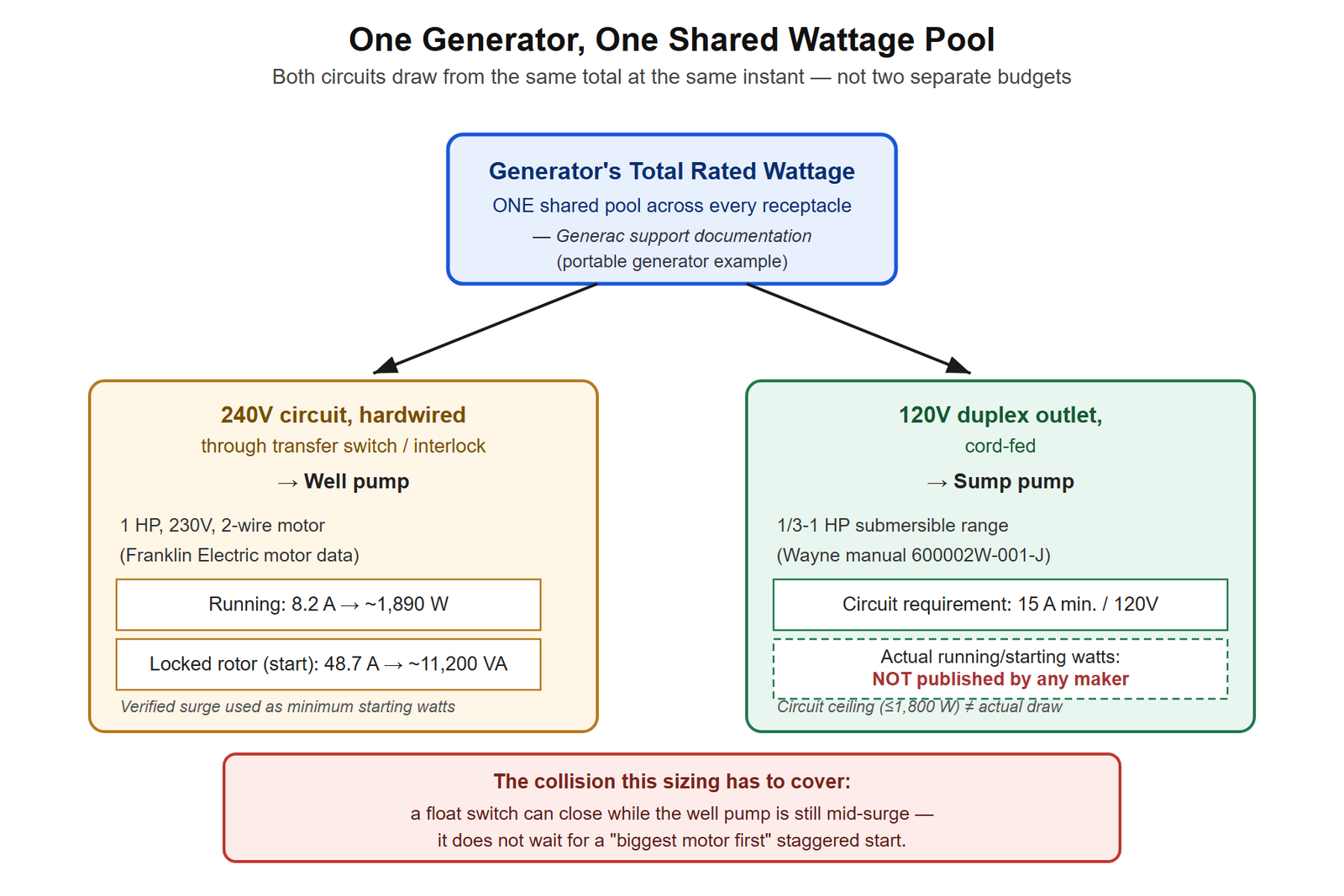
Every round-up on this topic treats a well pump’s power and a sump pump’s power as if they come from different places on the generator — a “big” output for the well pump, a regular outlet for the sump pump. They don’t. Generac’s own support documentation is explicit: a portable generator’s rated wattage “represents the maximum total electricity… that a portable generator can provide with any combination of two or more of its available receptacles.” The 240V side that feeds a transfer switch or interlock for your well pump, and the 120V duplex outlet your sump pump is plugged into, are the same engine turning the same alternator. There’s one number, and both pumps spend out of it.
This matters because the generic sizing tables everywhere online treat “well pump wattage” and “sump pump wattage” as two line items you add to a shopping list of appliances. They’re not independent purchases. They’re two straws in the same cup.
The Combined Number: A 1 HP Well Motor’s Locked-Rotor Surge Against a Sump Pump’s Circuit
Franklin Electric’s submersible motor data (already verified on this site for a 1 HP, 230V, 2-wire motor) gives full-load current of 8.2 A and locked-rotor current of 48.7 A. At 230V, that’s roughly 1,890 W running and roughly 11,200 VA instantaneous during the start. That starting number is nearly six times the running number — it’s the price of asking a submersible motor to go from standstill to full speed in a fraction of a second, and it’s gone again within a couple of seconds once the motor’s up to speed.
The sump pump side of the equation is honestly incomplete, and it’s worth saying why rather than papering over it. Wayne’s manual specifies a 120V, 60 Hz power supply and a 15 A minimum circuit across its whole ⅓–1 HP sump range — that’s a circuit requirement, not a published running or starting wattage. No manufacturer manual read for this site gives a locked-rotor or starting-watt figure for a residential sump pump. Every “800–1,200 running watts, 1,300–2,900 starting watts” range circulating on generator-sizing blogs is unattributed to any pump maker, and this site already declined to print it once, in running a sump pump on a generator. That refusal still holds here. What you actually know about the sump pump’s draw is its circuit’s ceiling — up to 1,800 W (15 A × 120V) — not its real consumption, which is almost certainly lower while running and unknown at the instant it starts.
A Float Switch Doesn’t Wait for the “Start Your Biggest Motor First” Advice
Nearly every portable generator’s owner’s manual gives the same staggered-start procedure. A Snapper/Briggs-platform manual, representative of the instructions reproduced across several portable generators in this family, spells it out step by step: start the engine with nothing connected, plug in the largest load first, let the output stabilize, then add the next load, repeating for each one. NDSU Extension’s generator-selection guidance says the same thing in different words — start the largest motor first, add others only once it’s up to speed, “do not add too much too fast.”
That advice assumes a person is standing at the generator deciding what to plug in and when. A well pump’s start is already somewhat predictable — it kicks on when the pressure switch calls for it, which a homeowner monitoring the panel can anticipate. A sump pump’s float switch has no such courtesy. It starts the instant the water in the pit reaches its on-level, outage or no outage, generator running or not, and it will do that regardless of whether the well pump happens to be mid-surge at that exact second. The staggered-start method every manual recommends simply doesn’t apply to a load with no human in the loop.
That’s the actual risk this sizing exercise exists to cover — not “will the generator run both pumps,” but “what happens if both pumps want to start within the same second.” A generator sized only for the well pump’s surge, with no headroom left over, can be pushed past its limit by a float switch closing at the wrong moment. Forum accounts of this collision (TractorByNet threads on sizing a generator for a well pump and a sump pump turn up the same complaint repeatedly) describe it plainly: the generator is already straining to start the larger motor, and a second load trying to start at the same instant doesn’t get the current it needs — the breaker trips, or the bigger motor stalls before it reaches speed.
Sizing It Anyway: A Worked Example
Here’s how to apply the verified numbers above conservatively, since nobody — including this article — has a published sump-pump surge figure to plug into a clean formula.
Start from the only hard surge number you have: the well pump’s locked-rotor draw, roughly 11,200 VA for the 1 HP 230V 2-wire example above (recalculate for your own motor’s nameplate amps if it differs — a 2 HP 3-wire motor’s locked-rotor current runs only about 10% higher than the 1 HP 2-wire figure, so horsepower alone is a poor guide). That surge number is your generator’s minimum starting watts rating, full stop, before the sump pump enters the picture at all.
Then add running-watts headroom for the sump pump that isn’t eaten by the well pump’s surge — not its unverified starting watts, which nobody can give you honestly, but enough margin that a sump pump drawing somewhere under its 1,800 W circuit ceiling can start without being starved the instant it’s needed. In practice that means treating the well pump’s running draw (≈1,890 W) plus a reserved block in the 1,000–1,800 W range for the sump pump as your running-watts floor, on top of the 11,200 VA starting-watts floor — then adding the standard 10–25% margin general sizing worksheets apply across the board. That pushes a household already needing roughly 11,200 starting watts for the well pump alone toward a generator rated nearer 12,500–14,000 starting watts once the sump pump’s worst case is covered, rather than whatever number a well-pump-only calculation gives you.
This isn’t a manufacturer’s figure — it’s this site’s own conservative application of the verified pieces, stated as that rather than dressed up as a spec. If your well motor’s nameplate numbers differ from the 1 HP 2-wire example, redo the arithmetic from your own tag before buying anything.
Where This Stops Being a Weekend Project
A well pump’s circuit is almost always hardwired 230V, and feeding it from a portable generator safely requires a listed transfer switch or interlock kit installed by someone who can verify it prevents backfeed into the utility line — connecting a generator to a well pump’s circuit without one is a shock and fire hazard to utility workers as well as your own household, and it’s a code violation in every jurisdiction that has adopted the NEC’s transfer-equipment requirements. The sump pump side is comparatively simple — it’s a cord-fed 120V appliance you plug straight into the generator — but the well pump side is an electrician’s job, not a DIY afternoon, and it’s the one part of this project where getting it wrong doesn’t just cost you a pump.
A Battery Backup Covers the Gap a Generator Can’t
For a share of readers, the honest answer to “what generator do I need” is “none, for the sump pump side” — Wayne’s own manual rules its submersible sump pumps out from portable generator use entirely, and a float switch that can’t be staggered is exactly the load a generator handles worst anyway. A battery backup sump system sidesteps both problems: it needs no transfer switch, no staggered start, and no person present deciding when to plug it in, because it’s already wired in and waiting. This site’s own buying guide to battery backup sump pumps covers the capacity math in detail, including why the GPH rating on the box is the wrong spec to compare between models. If you’ve already settled on a specific pump and just need the battery itself, what size battery for a backup sump pump matches the capacity to the runtime claim it was quoted against.
FAQ
Can I run my well pump and sump pump off the same generator if I just use two different outlets on it?
No — a portable generator’s rated wattage is one shared total regardless of which outlets you use, per Generac’s own support documentation. Plugging the well pump into the 240V side and the sump pump into a 120V outlet doesn’t give you two separate wattage budgets; it’s still one engine and one alternator supplying both.
Does an inverter or dual-fuel generator change any of this math?
No. The starting-versus-running-watts distinction and the single shared total both come from how the alternator and engine deliver power, not from the fuel type or whether the unit is inverter-based. An inverter generator’s cleaner waveform is a separate question from how many total watts it can produce.
What if my sump pump already has its own battery backup?
Then the backup battery, not the portable generator, is what carries the sump pump through the outage, and you can size the generator for the well pump alone using the method in sizing a generator for a well pump. The two systems don’t need to be reconciled against each other — the battery is already handling the load the generator struggles with.
Size for the Collision, Not the Addition
The number that actually matters here isn’t the well pump’s running watts plus the sump pump’s running watts — it’s whether the generator has enough headroom left over after the well pump’s locked-rotor surge to absorb a float switch closing at the same moment, on a machine that one major manufacturer says shouldn’t be on a portable generator at all. Verify your own well motor’s nameplate amps, read your own sump pump’s manual before assuming it’s covered, and size for the worst second, not the average one.