On this page
- Dry it off first and watch where the water comes from
- Condensation looks exactly like a leak until you check the temperature
- Why a sound tank still rusts through from the outside, not the inside
- The failure itself: what you're actually looking at, and what to do about it
- What your warranty actually covers before you call it in
- When replacement is the answer
- When this needs a pro
- FAQ
Last Updated on October 17, 2026 by umar bwn
Two very different problems look identical the first time you find water at the base of your pressure tank. One is a tank that’s rusted through and needs replacing. The other is condensation, and the tank is fine. The difference comes down to a single question you can answer in about five minutes: is the water there because the tank is cold, or because the steel has actually failed? Dry everything off, and what comes back — and how fast — tells you which one you have.
Dry it off first and watch where the water comes from
Before you diagnose anything, find out whether the water is even coming from the tank itself. A good number of “leaking pressure tank” calls turn out to be a fitting — the pressure gauge, the relief valve, the drain valve, or the tank tee up top — weeping onto the shell and running down to pool at the base, which looks exactly like the tank itself leaking from underneath.
One-minute test: Wipe the entire tank bone dry with a rag — top, sides, every fitting, and the floor underneath. Note the time. Come back in fifteen minutes with the pump running normally through a couple of cycles.
- Wet fittings at the top, with a dry trail running down the dry shell → it’s a fitting, not the tank. Tighten or replace whichever one is wet (gauge, relief valve, drain cock, isolation valve) and you’re done.
- The shell itself is damp, but only low down near the floor, and it reappeared slowly and evenly → keep reading, this is the condensation check below.
- Water is actively beading or dripping from a specific spot on the steel itself, especially near the base or along the seam where the dome meets the cylinder → that’s the tank failing. Skip to the rust-through section.
Condensation looks exactly like a leak until you check the temperature
This is the single most commonly missed step, and it’s the reason people nearly replace a perfectly good tank. Well water sitting in the tank is often in the 50s°F, and in a humid basement or crawlspace, that’s cold enough for the tank’s steel shell to sweat the same way a glass of ice water does on a summer day. The moisture collects at the base — the same spot a real leak shows up — because the composite base lifts the shell slightly off the floor and that’s where runoff and condensate both end up pooling.
One-minute test: Dry the tank completely, then leave the pump untouched for several hours — long enough for the water inside to warm to room temperature instead of sitting at supply temperature. Check it again without running the pump first.
- Dry → it was condensation. No fault, no action needed beyond maybe improving ventilation or dehumidifying the space if it bothers you.
- Wet again, with no pump cycle in between → that’s not sweat, something is actually leaking.
If you’ve been chasing a “leak” that only shows up after the pump has been running a lot and dries up on its own overnight, condensation is very likely your answer before you’ve spent a dollar on anything.
Why a sound tank still rusts through from the outside, not the inside
Once you’ve ruled out condensation and a loose fitting, the water is coming from the shell itself — and here’s the part most advice skips entirely. On a modern diaphragm or bladder pressure tank, the stored water never actually touches the bare steel shell. A diaphragm (or liner, depending on the model) isolates the water chamber from the outer wall. That means when the outside of the tank rusts through, it isn’t because the stored water is corroding the steel from the inside the way it would in an older, non-bladder tank. It’s an exterior moisture problem — standing water on the floor, chronic condensation, a wet sump pit nearby, salt-laden air near the coast — attacking the shell from the outside in.
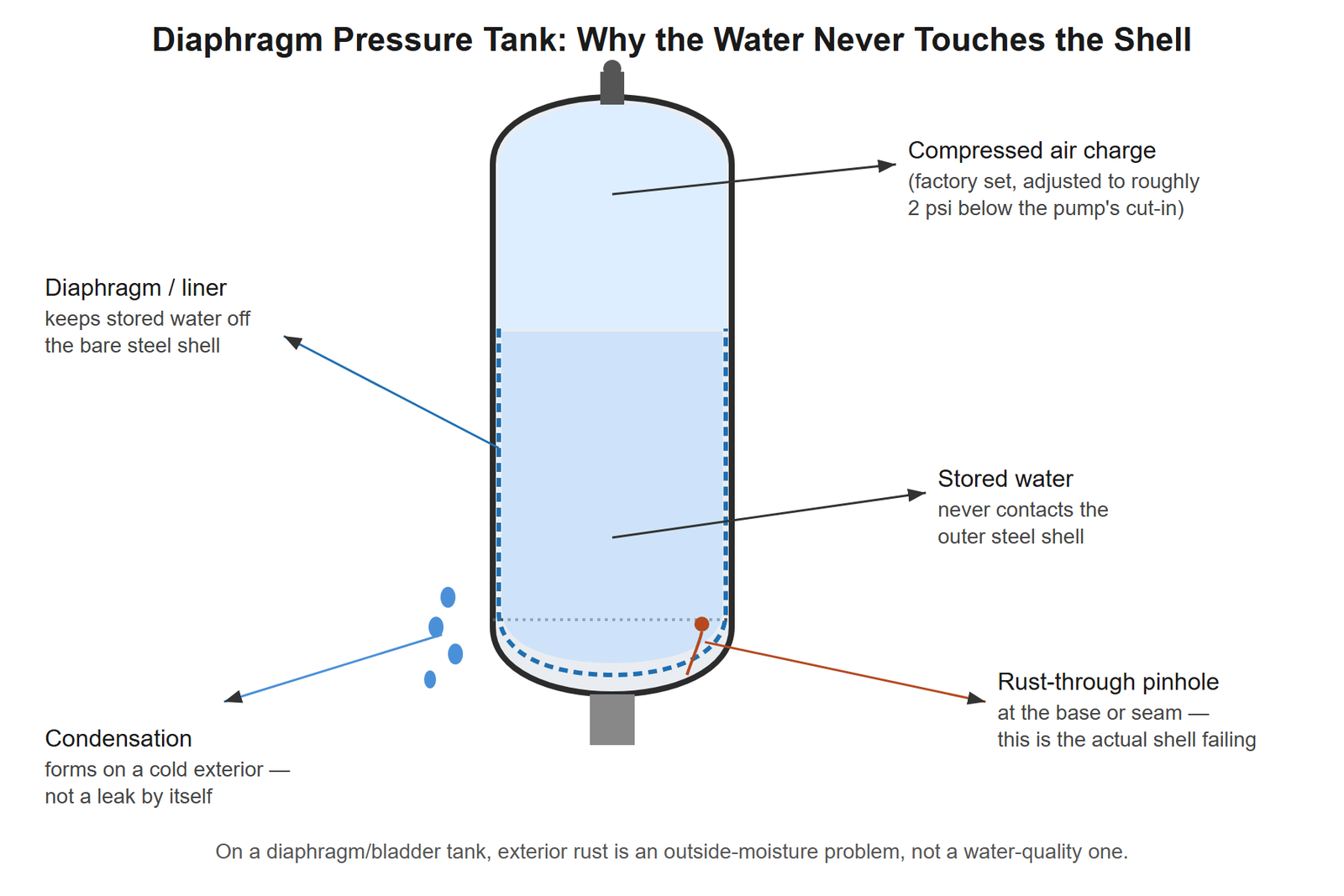
That distinction matters for what you do next. It means a rusted-through base isn’t a sign your water is somehow eating the tank — it’s a sign the tank has been sitting wet (or damp) for a long time, from the outside. If the floor around the tank stays wet for other reasons, a replacement tank will eventually fail the same way unless that’s fixed too.
The failure itself: what you’re actually looking at, and what to do about it
Rust-through pinhole, mid-panel. This is the most common pattern — a small weeping spot or a visible pinhole somewhere on the flat section of the cylinder, usually low down where moisture collects. If you can see active rust bubbling through the paint or primer, with flaking and a rough, pitted texture underneath, the shell has already thinned enough to let water through. There’s no reliable age number that predicts this — tanks quoted anywhere from 10 to 25 years online, but none of that comes from a manufacturer spec sheet. The paint-through rust is the real tell, not the tank’s birthday.
One-minute test: lightly scratch at the rust spot with a fingernail or flathead screwdriver. If it flakes away to reveal more rust rather than solid metal, the corrosion goes deeper than the surface.
Fix: replace the tank. A lag-screw plug with a neoprene washer or a quick-set epoxy patch can buy you a few days if you’re mid-emergency and can’t get a tank until tomorrow, but every account of this from actual repair threads describes it as buying time, not fixing anything — the surrounding steel is thinned the same way the hole itself was.
Failure at the seam or weld, not mid-panel. If the wet spot traces back to the horizontal seam where the dome meets the cylindrical body, treat it differently than a mid-panel pinhole. Working plumbers on forums specifically warn against trying to weld or re-seal a rust-thinned seam — heat on steel that’s already corroding from within the seam tends to open up more cracks along the weld line rather than sealing anything, because the thinning typically isn’t limited to the one spot you can see.
One-minute test: run a finger along the seam line itself, not just around the wet spot — if the rust and pitting extend along the seam rather than sitting in one contained patch, that confirms seam failure rather than an isolated puncture.
Fix: replace the tank. Don’t attempt a weld or a patch at a seam specifically — it’s the one failure mode where even a temporary fix is more likely to make the leak worse than to slow it.
What your warranty actually covers before you call it in
Before you call the manufacturer expecting a free replacement, know what a typical pressure tank warranty excludes. Amtrol’s own limited warranty for its Well-X-Trol residential tanks (seven years on tanks made from April 1, 2010 onward) specifically carves out coverage for “any problem, failure or malfunction resulting from… improper or negligent handling… improper storage, accident, lightning, flood or any other environmental condition.” A tank that’s rusted through because it’s been sitting in a damp corner or next to a sump pit that floods periodically is very likely describing exactly the kind of environmental cause that warranty language is written to exclude — age against the term isn’t the deciding factor, the cause is. Check your own tank’s specific warranty document before assuming age alone qualifies you.
When replacement is the answer
Once you’ve confirmed an actual rust-through — not condensation, not a loose fitting — replacing the tank is the only real fix regardless of which failure pattern you found. If you’re choosing a replacement, our well pressure tank buying guide covers sizing by drawdown, bladder versus non-bladder construction, and specific models still in production, so you’re not guessing at capacity on top of everything else.
While you’re in there, it’s worth checking your air charge on the new tank before it ever sees water — a tank installed with the wrong precharge waterlogs early and can make a perfectly good new tank look like it’s already failing. If the pump is also short-cycling or won’t shut off once you’ve got the new tank plumbed in, that’s a pressure switch problem, not a tank problem, and worth ruling out separately before you blame the new tank for a switch issue.
When this needs a pro
Isolating and swapping the tank itself — shutting the valve, draining it down, unthreading the tank tee — is plumbing work most comfortable DIYers can handle with the system off and drained. Where this stops being a solo job: if the leak has been pooling anywhere near the pressure switch or a well pump control box, shut the breaker off before you touch anything wet. Those terminals carry full line voltage, not a low-voltage signal, and standing water near an energized splice is the one part of this job that isn’t a towel-and-wrench situation. If the tank sits in a pit, a finished space where you’d need to cut into a wall, or anywhere your local code requires a permit for pressure vessel work, call a licensed plumber or pump installer instead of improvising around it.
FAQ
How long should a pressure tank last before it rusts through?
There’s no reliable number to give you — figures floating around online range from 10 to 25 years, and none of them trace back to an actual manufacturer spec sheet. What predicts failure isn’t the tank’s age, it’s whether you can see active rust coming through the paint or primer on the outside. A ten-year-old tank sitting in a chronically wet spot can fail before a twenty-year-old one kept dry.
Can I weld or patch a rust hole in a pressure tank myself?
You can buy a few days with a lag-screw plug and a neoprene washer or a quick-set epoxy, and that’s genuinely useful if you’re stuck without a replacement tank until tomorrow. But treat it as a stopgap, not a repair — and don’t attempt it at all if the rust is along the seam rather than in the middle of a panel, since heat or pressure on a rust-thinned seam tends to open more cracks rather than seal the one you can see.
Is a leak from rust covered under the tank’s warranty?
Check the specific document, but don’t assume so. Amtrol’s limited warranty for its Well-X-Trol residential tanks explicitly excludes failures caused by “flood or any other environmental condition” and “improper storage” — language that describes a lot of rust-through cases, which are caused by the tank sitting somewhere damp rather than a manufacturing defect. Being within the warranty’s term doesn’t automatically mean the cause is covered.
Does rust on the outside of my tank mean my water is contaminated?
Not on a diaphragm or bladder tank. The stored water is isolated from the outer steel shell by an internal diaphragm or liner, so exterior rust is a sign of outside moisture attacking the shell, not the water itself causing corrosion from the inside. The water quality and the shell’s exterior condition are two separate issues.