On this page
Last Updated on September 14, 2026 by Muhammad Toqeer
Two very different problems hide behind this. If your pump is the kind you drop into the water, it has no priming step at all and never did — something else is wrong. If it sits on the floor with a hose running down to the water, start by filling it: even a self-priming pump has to be filled by hand before its first run.
Those two cases have almost nothing in common, so sorting them takes ten seconds and saves an afternoon.
Does your pump prime at all?
A submersible utility pump goes in the water. Its impeller is flooded the moment you lower it in, so there is nothing to prime, no priming plug and no suction hose. If priming keeps defeating you and the job is a wet floor rather than a long uphill run, a submersible is simply the better tool — which one depends on how dry you need the floor.
Only non-submersible pumps — the ones sold as transfer pumps — have to lift a column of water up to themselves. Wayne says which theirs is in one line: “The motor is air cooled; it is not designed to operate under water.”
One-minute test: look at where the water enters. A hose clamped to an inlet fitting on a pump sitting in the dry means a transfer pump, and everything below applies. A pump with a cage or screen on its base that you lower into the water is a submersible, and “won’t prime” is the wrong description of what is happening — that is a different fault.
Fill it. Every time it has been apart or dry.
“Self-priming” is one of the more misleading terms in the trade. It does not mean the pump primes itself from empty.
Pumps & Systems puts it plainly: “Even a self-priming pump has to be primed prior to the first operation”, because “there is a priming chamber (integral or external) or some portion of the volute that will require filling prior to startup.”
Wayne’s manual carries it as a boxed warning: “Pump must be filled with water before operation. Running the pump dry will cause damage to the shaft seal.” And the procedure: “Remove priming plug and fill with water. Replace plug (plumbers seal tape should be used on priming plug to prevent air leaks).”
Read that last parenthesis again. The manufacturer is telling you the priming plug is itself a likely air leak. Tape it. A plug that is finger-tight and dry looks perfectly closed and can still be feeding air straight into the pump.
Fifteen feet — and it counts sideways
This is the specification people get wrong most often, because it is not written the way they expect.
Wayne: “In no case should the pump be more than 15 feet above or away from water source. Install a foot valve to keep it self-priming.”
Above or away. The manufacturer is not separating vertical lift from horizontal distance on the suction side — both spend the same budget. A pump sitting twelve feet back from a pond, at ground level, is already close to the limit before it has lifted anything at all.
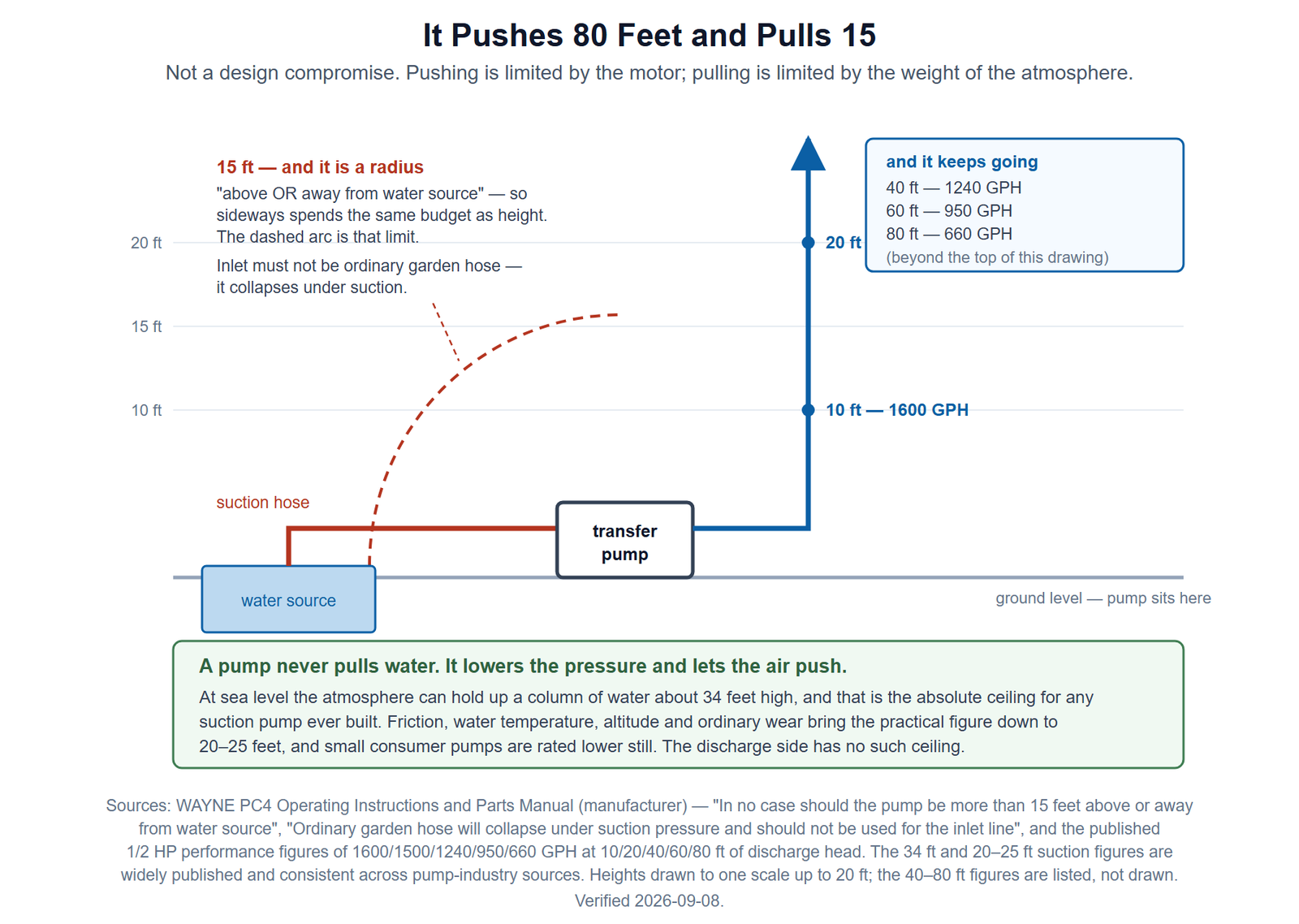
Why it pushes 80 feet and only pulls 15
The asymmetry looks like a defect until you know what is doing the work.
The same 1/2 HP pump moves 1600 gallons an hour against 10 feet of discharge head, and still 660 an hour at eighty feet. Eighty feet up, on the push side. Fifteen feet on the pull side.
A pump does not pull water. It lowers the pressure at its inlet and lets the atmosphere push water up into the gap. At sea level the atmosphere can support a column of water about 34 feet high, and that is the hard ceiling for any suction pump ever built. Friction, water temperature, altitude and ordinary wear bring the working figure down to about 20 to 25 feet, and small consumer pumps are rated lower still.
So pushing is limited by the motor, which you can buy more of. Pulling is limited by the weight of the air, which you cannot.
The practical version: if the pump will not prime and it is sitting well back from the water, move the pump closer before you take anything apart.
A suction leak does not drip
Here is the one that defeats people, and it is genuinely counterintuitive.
The suction line runs below atmospheric pressure. As Pumps & Systems notes, that means liquid will not leak out of it — but “there can…be a leak of air into the line.” A joint can be wide open and show you nothing. No drip, no damp patch, no stain.
So the usual method fails completely: you inspect every fitting, find no water anywhere, and conclude the plumbing is fine. Wayne’s warning is that “small leaks in suction line greatly reduce efficiency of pump and may prevent priming” — small being the operative word.
One-minute test: wrap plastic film tightly around each suspect joint while the pump is running and watch. It is the trick a pump engineer uses — “I frequently use plastic wrap around the flanges or suspected areas to test for ingress leaks.” If the wrap sucks in against the fitting, or the pump suddenly starts pulling water, you have found it.
Two other suction-side specifics from the manual, both easy to get wrong:
- Ordinary garden hose is the wrong inlet hose. “Ordinary garden hose will collapse under suction pressure and should not be used for the inlet line.” A collapsed hose looks fine at rest and shuts flat the moment the pump starts.
- The inlet line should be the same size as the pump’s inlet. On self-priming pumps the suction piping “should be the same size as the pump suction” — the opposite of the rule for ordinary centrifugal pumps, where you would size the suction line one step larger.
Four minutes, then stop
Nobody writing for homeowners gives a stop rule, so people keep restarting a dry pump for half an hour.
The trade figure is specific: “if your pump takes more than four minutes to prime than you should shut the pump down and look for and correct the cause.”
Wayne is looser — “The pump will prime in a few minutes depending on suction line length” — but four minutes is the number worth holding, because everything past it is running dry, and running dry is exactly what the manual says destroys the shaft seal.
Won’t prime, or won’t hold prime?
Worth separating, because they point at opposite ends of the hose.
- It has never primed on this setup. Nothing in the casing, a collapsed or undersized inlet hose, a suction leak, or simply too far from the water.
- It primes fine, then loses it between uses. The water is draining back down the suction line while the pump sits. That is a foot valve — missing, stuck open, or fouled. Wayne’s guidance is to fit one “when pumping from a creek, pond, or source where foreign objects may be sucked into the pump”, and to install one specifically “to keep it self-priming.”
The second case is often mistaken for the first, because the symptom you see is identical: you switch it on and nothing happens.
When this needs a pro
Most of this is hose work and a jug of water. Two things are not.
The pump has to be on a GFCI-protected outlet — the manual says so directly, and the reasons are covered in the utility and transfer pumps guide. A GFCI that trips the instant you reset it, every time, is an electrical fault and an electrician’s job, not something to work around by finding an unprotected outlet.
And if you have run it dry for a long stretch chasing the prime, the shaft seal may already be gone. A pump that now leaks from between the motor and the volute is telling you that happened, and that is a repair or a replacement rather than a priming problem.
FAQ
Why won’t my transfer pump pick up water?
Most often because the pump casing is empty, there is an air leak on the suction side, or the pump is further than about 15 feet from the water — counting horizontal distance as well as height. Fill the casing first, since that is both the most common cause and the fastest to rule out.
Do submersible utility pumps need priming?
No. A submersible sits in the water and its impeller is flooded as soon as you lower it in. There is no priming plug and no suction hose. If a submersible is running without moving water, that is a different fault entirely.
How long should a pump take to prime?
Under four minutes. The trade guidance is to shut it down past that point and find the cause, because anything beyond is running dry, and running dry damages the shaft seal.
Can I use a garden hose on the suction side?
No. The manufacturer is explicit that ordinary garden hose collapses under suction pressure and should not be used for the inlet line. It will look perfectly normal until the pump starts, then flatten shut.
Why does my pump lose prime between uses?
The water is draining back down the suction line while the pump is off, so the next start begins dry. That points to a foot valve at the bottom of the suction line — either missing, or stuck open by grit.


